___________________________
ii iv viii Taxatio:
A Better Tax Blend
by Eugene Patrick Devany,
J.D., M.P.A., April 15, 2015
Prepared for the United
States Senate Committee on Finance
Introduction
The 2-4-8 Tax Blend is a bold and simple tax reform
plan. The name is derived from the approximate tax rates that would be
employed: 2 percent elective wealth tax, 4 percent VAT and 8 percent income
tax. Even with very low tax rates, government revenue would meet or exceed
receipts under the current code due to the expanded tax bases. The changes
are designed to achieve the following objectives:
1.
Replace tax expenditures with minimal hardship
2.
Create sustained full employment
3.
Eliminate tax inequality and reverse downward family
wealth trends
All can be accomplished with no net increase in
government spending and without traversing most contentious partisan tax
issues. The 2-4-8 Tax Blend is proof that broad liberal economic objectives
can be achieved with very conservative policies.
In Part II there is a discussion of tax philosophy,
competing tax reform suggestions, spending and details on selected issues.
For focus and scope, particular emphasis is placed on responding to the
Heritage Foundation's Backgrounder, "A Tax Reform Primer for the 2016
Presidential Candidates", by Curtis S. Dubay and David R. Burton, April 7,
2015.[1]
Part I
Objective 1:
Replace Tax Expenditures with Minimal Hardship
Solution:
A VAT and Very Low Business Tax Rates
Most tax expenditures are intended for specific
investment activities. When tax rates are too high, congress has
historically helped some by enacting tax expenditures (credits, deductions,
special rates, deferrals and exemptions). Unfortunately, the incentives
distort business decisions and cause the economy to perform less
efficiently. Regulations may have a similar distorting impact. Sometimes tax
expenditures are contradictory by encouraging business investment and
another rewarding charity which discourages business investment. Some tax
expenditures benefit important industries like electric cars, wind power,
private jets or movie making. Others exempt or postpone taxes with
questionable public benefit.
Q
Other things being equal, lower tax rates with fewer
tax expenditures and less regulation are better for free market efficiency.
Tax Expenditures amount to 7.5 percent of GDP while other government
spending is only 5.2 percent of GDP. When graphically matched against the
federal budget (above), it is easy to see the scope of the problem.
The evaluation of tax expenditures by the Senate
Finance Committee and its Subcommittees would be much easier if businesses
would provide a clear consensus that they are willing to forgo tax
expenditures for a low income tax rate sweetened by the elimination of
payroll taxes. The introduction of a 4 percent VAT[2]
(the lowest in the developed world) would permit reduction of the C
corporation income tax rate to just 8 percent flat and the elimination of
payroll taxes. Pass-through businesses could enjoy the same rates. Low rates
make it difficult for any business to argue that preferential tax treatment
is needed[3].
Objective 2:
Create Sustained Full Employment
Solution:
Replace Payroll Taxes, Let Charities Provide Transitional Jobs
Reliance on the payroll tax portion of the income tax
base, in addition to the non-payroll portion of the income tax base, has led
to high tax rates and many tax credits with unintended consequences. For
example, even the earned income tax credit, originally designed to help
offset high payroll taxes, has resulted in the gradual expansion of low wage
and part time jobs.
Payroll taxes are not the only way to fund Social
Security and Medicare, as many cosponsors of the Fair Tax Act[4]
bill know. Rather than imposing a large national sales tax, business tax
reform (as described above) would replace the payroll tax revenue while
easing the burden on workers. Bill Gates[5]
and economist, Casey B. Mulligan[6],
have spoken about how full employment is encouraged by un-taxing jobs for
businesses and increasing worker take-home pay by 7.65%. No payroll taxes
for U.S. businesses means less outsourcing and higher salaries to encourage
near full employment. More spending as a direct result of the elimination of
the worker's tax share, also produces a sustained increase in consumer
demand.
Actual full employment could be achieved by creating
transitional jobs with charities paying a little below typical private
business salaries. The jobs would range from basic to professional -
whatever the charity required. The program would be paid for primarily by
limiting use of the charitable tax deduction to charities that voluntarily
agree to expand their services with a portion of the contributions received.
There is no fixed or rigid limit on the scope of services that can be
provided to the young, old and infirm. The maintenance of parks and public
facilities can also be enhanced. The transitional jobs program should expand
and contract inversely with the needs of the private economy. Fewer
transitional jobs are needed when the economy expands while more are needed
in times of recession and contraction. Charitable foundations that pass on
funds to service charities would keep track of U.S. job requirements and
accumulate funds over several years. Thus more money would be available for
transitional jobs during economic downturns. Businesses would benefit by
having a workforce with sharp skills at the ready. Workers and their
families benefit by having supportive transitional jobs available in times
of need. The transitional jobs program should also be combined with
training, formal education, transportation, child care and health care in
accordance with revised rules for consolidated and flexible programs.
Objective 3:
Eliminate Tax Inequality and
Reverse Downward Family Wealth Trends
Solution:
Flat Tax - Wealth Tax Option for Lower Wealth Families
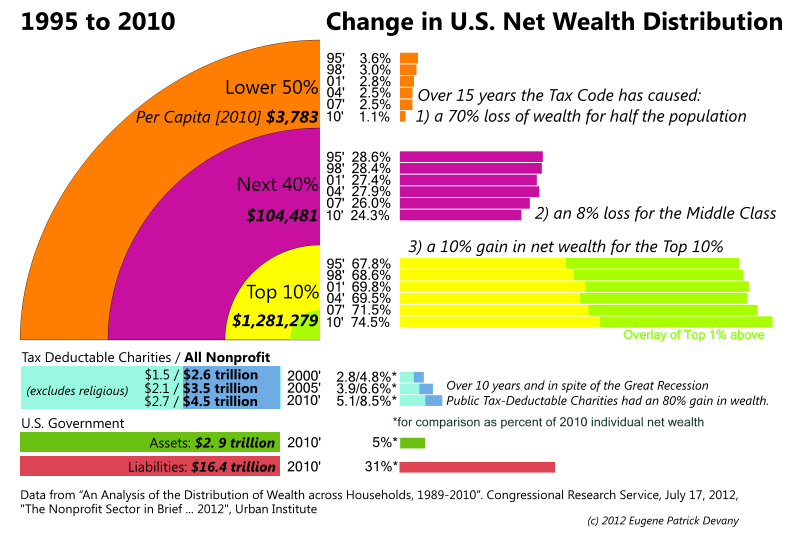
Since 1995, the wealthiest 10% of the population
increased their share of individual wealth from 67.8% to 74.5%. The next 40%
(the middle class) saw their share decline from 28.6% to 24.3% (trending
toward the 12% global middle class average). Total individual wealth
increased significantly from 2010 going from $56 trillion to over $83
trillion today. Thus the middle class decline in share of wealth is somewhat
mitigated by being a modestly smaller share of a much larger pie.
The poorer half of the U.S. population (working
class) is in crisis going from a 3.6% share of wealth to just 1%. In fact,
the poorest 25% actually have negative wealth largely due to student loans,
mortgages and credit debt (in that order). The economic hardship has
produced negative effects on marriage formation and child rearing.
If tax reform can reverse the wealth trends by
letting low wealth families keep more of their earnings, it is a formula
worth considering. The optional net wealth tax in the 2-4-8 Tax Blend does
this by permitting those who choose to pay a net wealth tax of 2 percent to
obtain a large income tax reduction - paying an 8 percent rate instead of a
26 percent rate.
The top income tax rate of 26 percent is consistent
with many reform proposals. It is a bit higher than options which do not
include payroll tax replacement but lower than what most popular reform
plans are able to achieve. The charitable tax deduction would be retained
for the 26 percent rate to fund the transitional jobs program described
above. Other tax expenditures would be eliminated and capital gains, gift
and estate taxes would be subject to the same 26 percent rate as all other
income. The stepped-up basis for appreciated property in estates would be
eliminated and subject to capital gains taxation.
The taxpayer wealth tax election would exclude
$15,000 cash and $500,000 per person in tax free savings. Wealth taxpayers
would pay no capital gains, gift or estate taxes. Thus, the wealth tax
option would be economically attractive to most taxpayers, including a
substantial number of high wealth and high income taxpayers. Many taxpayers
would value the ability to change investments tax free as part of their
retirement or business plan.
While few doubt that simple income tax rates of 8 or
26 percent can be administered efficiently by the IRS[7],
the computation of debt and the average value of a half dozen categories of
assets need not be difficult. Most of the task can even be automated for the
majority of taxpayers. Wealth tax reporting should take up no more than a
one page form. As with current deductions and income, the taxpayer would be
responsible for maintaining reasonable proof of the subtotals. Since wealth
is taxed at just 2%, the accuracy of any estimate[8]
is less significant than with a higher rate.
[9]
Unlike the time wasted in most IRS computations, the
practice of maintaining a balance sheet is useful for all taxpayers. The
vast majority of individuals will see growth year to year[10]
and appreciate the tax code that actually helps to make it possible. Those
who don't see growth may find more willing support from a government that
can readily use family wealth, rather than just income, as a fair measure of
poverty and need. For example, instead of providing child care income tax
credits it might be more efficient to provide financial support to the
custodial parent or parents as a spending program for children from low
wealth families with a wider range of income[11].
Spending programs can be better supervised to make sure that funds are paid
only to parents that are providing proper care and coordinated with other
government programs.
The wealth tax computation also permits the deduction
of debts from assets for a 2 percent tax savings that would effectively
replace and improve upon the current deductions for mortgage and student
loan interest. The government retains a fair share because one person's tax
deductable debt is another's taxable asset.
If, over the course of a decade, the wealthiest 10%
slowly decreased their share of wealth from 75 percent to 70 percent, the
wealthy would still gain with a slightly smaller share of a much larger pie.
More importantly, this would leave enough share (5 percentage points) to
double or triple the family wealth of the poorer half of the population and
reverse the decline of the middle class.
Part II
Should All
Income Saved and Invested be Tax Exempt?
According to the Heritage Foundation, "The best way
for tax reform to achieve [its] goals is ... to establish a consumption
base, which is any system that taxes income that is spent, but not income
that is saved and invested." There is a genuine concern for double taxation
(discussed separately below) and the implicit assumption that ordinary
people need some tax incentives to help them save is no doubt true. However,
once investment level wealth (i.e. $500,000) has been accumulated,
individuals need no further government incentive. A half million dollar
retirement fund (or a million dollars for two persons) is sufficient to
supplement Social Security and provide a modest middle class lifestyle in
retirement. More importantly, the wealth distribution trends show that,
taken together, 90 percent of the population could be expected to save only
two or three percentage points of total available wealth while 50 percentage
points or more is already saved and invested by the wealthiest 10 percent.
Tax provisions that apply unlimited incentives to all savings and investment
would help the very wealthy by a factor of twenty to one and require much
higher tax rates than would otherwise be necessary. Even the proposed
$500,000 per person limit would actually help wealthy investors by a factor
of at least ten to one because they would achieve tax free advantages
earlier in their work life and enjoy them longer. Higher than necessary tax
incentives to induce savings can be a flaw in tax reform, but unlimited
incentives are a major flaw all too common in the global political
competition for wealth (discussed further below). Each of the four
consumption taxes outlined by the Heritage Foundation (and discussed further
below) provides incentives in the form of financial exemptions where none
are needed.
The 2-4-8 Tax Blend provides reasonable incentives
for all to reach a middle class level of savings. The incentives for those
who elect to pay the wealth tax include:
·
a low flat 8% income tax rate
·
wealth tax exemptions up to $500,000 per
person for retirement, health care, home down payment and/or education
·
$15,000 per person cash/bank savings
exemption
·
elimination of capital gains and gift taxes
·
elimination of estate taxes
·
transitional jobs in times of need
Those who have enough wealth to elect to pay a 26
percent income tax rate rather than a 2 percent wealth tax obviously need no
government tax help to save or invest. C Corporations can obtain the benefit
of a low 8% income tax rate without concern for a wealth tax.
Double
Taxation Can Be Fair if Existing Rates are Reduced Significantly
The Heritage Foundation correctly notes, "Income that
is saved or invested is taxed, and the return on that savings or investment
is then taxed again. Moreover, income from investments in corporations is
double taxed again - first at the corporate level and then when individuals
receive dividends or pay capital gains on corporate stock. By double or
treble taxing saving and investment at high rates, the tax code deters
families from saving for retirement, education, a rainy day, or for any
other purpose they desire." The important factor of "high" rates is often
overlooked because past efforts to solve the problem have been limited to
special tax exemptions while leaving other individual and business tax rates
high.
The 2-4-8 Tax Blend solves the problem by lowering
the corporate income tax to just 8 percent and allowing shareholders to
elect a 2 percent wealth tax and pay an 8 percent tax on dividends (and
avoid capital gains entirely). The combined "double taxation" rate of 16
percent is just a fraction of the current 35 percent corporate rate standing
alone. Even if a taxpayer who elected to pay a 26 percent income tax rate
were to consider the additional 8 percent corporate rate, the combined 34
percent "double taxation" rate is less than current top marginal rates for
either individuals or corporations. From an investment standpoint, most
taxpayers who elected the 26 percent rate would be investing to increase the
value of their assets rather than to produce a lot of taxable income.
"Consumption
Taxes" Leave Rates Too High for Most Taxpayers
A. The Flat Taxes
The Heritage Foundation provides summaries of its
view of "consumption taxes" which begin with the Traditional Flat Tax and
the New Flat Fax. For businesses, income includes only domestic income. This
may have the unintended consequence of encouraging businesses to shift
income to a foreign source - (a relatively easy task for global businesses
with competent tax attorneys). For individuals, there is a large standard
deduction (perhaps the size of the income poverty level) before the
significant flat tax rate begins on all non-exempt income. Savings and
investment under the Flat taxes are treated like Roth IRAs (Individual
Retirement Accounts). Growth from savings accumulates after taxes are paid
on earnings and later withdrawals from the account are not taxable.
Accumulations during intervening periods, including capital gains and
dividends, are not taxed.[12]
Financial transactions are disregarded when determining taxable income, so
interest income is generally tax exempt. "The New Flat Tax has one rate for
labor income, minus the amounts that families and individuals save." The New
Flat Tax allows[13]
pre-tax savings similar to an IRA and payment of taxes when funds are
withdrawn during retirement. Deductions are also permitted for charitable
contributions and (optionally) for mortgage interest (taxed to the lender).
The payroll taxes "can be rolled into either flat tax" for an estimated flat
tax rate of 28 percent[14].
Any suggestion that this is less than what middle class workers currently
pay comes from improperly attributing both the business portion of payroll
taxes and the individual portion (15.3 percent combined) to the worker. An
elimination and replacement of payroll taxes would increase worker take-home
pay by only 7.65 percent. Each business would be free to use the other 7.65
percent as it sees fit.
The Flat Tax rate of 28 percent is even higher than
the optional 26 percent tax rate in the 2-4-8 Tax Blend. Since most
taxpayers, given the choice, would choose the 2 percent wealth tax option
with 8 percent income tax rate, it is clear that the Flat Rate Tax and the
New Flat Rate Tax disproportionately help investors and harm workers.
Investors would obtain a windfall by eliminating taxation on financial
transactions such a dividends, interest and capital gains. It is worth
noting that individual wealth increased by approximately $27 trillion over
the last five years. Most of this economic income is from asset appreciation
(i.e. increases in stock value, etc.). Most of the appreciation has never
been taxed and would avoid taxation under the Flat Rate Tax plans as
described.
B. Sales Tax
A National Sales Tax, as outlined in the proposed
Fair Tax Act, is more easily understood as a consumption tax base with "all
consumption goods and services but no intermediate or investment goods or
services" subject to tax. The collection of the tax by retail businesses
eliminates the need for anyone to file income tax and eliminates major
functions of the Internal Revenue Service. The large tax rate of about 30
percent - exclusive, (23 percent - inclusive) and no individual deduction
makes the unadjusted tax extremely regressive. A monthly "prebate" check
would be sent to all according to family size and designed to reimburse the
tax that would be paid by a family spending up to the poverty level (no
matter how much money the family had in the bank).
Sending monthly checks to wealthy families does not
sit well with those who believe government discretionary spending can, and
should be, targeted based on need. Unlike the Fair Tax, the 2-4-8 Tax Blend
provides the government with both income and family wealth data essential to
fairly evaluate need. The high sales tax rate of the Flat Tax is combined
with state and local sales taxes in most jurisdictions, making the tax paid
by the consumer closer to 40%. Since this tax applies only to new goods,
individuals will be incentivized into purchasing used items (i.e. clothing,
electronics, furniture, toys, etc.) and local garage sales (and their
internet equivalent) will be more common. The unintended consequences
include not only the "second hand Rose" incentive, but also significant
economic loss to GDP by reducing the demand for new products. Lawful service
providers will also have to compete with individuals willing to risk evasion
of the law by offering to provide their services for a 50 percent cash
discount. Others may seek to sell their services by expanding the role of
nonprofits to provide a wider range of tax free services to the needy. The
bottom line is known well by all true conservatives - high tax rates always
cause big unintended problems.
C. Business Transfer Tax
The BTT (Business Transfer Tax) is a tax on, "revenue
from the sale of goods and services minus purchases of goods and services
from other businesses." Capital costs such as machinery and equipment would
be fully deductible and financial transactions (such as interest, dividends,
and capital gains) are not considered in computing the taxable base. Revenue
from exports is also excluded.
The changes in computing business income and profit
are so radical that a separate name, "BTT", has been given to this business
levy. Like the Flat Taxes and the Sales Tax described above, the key feature
is to remove investments and financial transactions from tax liability. The
BTT provides investors and owners with a broader range of tax free
compensation options. The tax favors automation (via immediate expensing of
capital costs) over job creation (because wages are not deductable). For
historical perspective, this tax was formally suggested in the 1995 USA Tax
Act when unemployment rates were low and before the sharp declines in family
wealth for 90 percent of the population. A BTT would be hard to consider
seriously after the Great Recession.
D. Value Added Tax
The Heritage Foundation discusses the VAT (value
added tax) under the heading "Additional Tax Systems" and contends, "There
is frequent talk by some that the U.S. needs to levy a credit-invoice
value-added tax (VAT). In addition to not raising taxes, tax reform should
not add new tax systems on top of the existing ones. Another tax system
would increase complexity and likely allow the federal government to extract
higher taxes from American taxpayers."[15]
There are a few VAT variations with the one
originally embraced by Rep. Paul Ryan being a "subtraction method VAT". In
general, it may be best to think generally of a VAT as a business income tax
that attaches to gross sales of goods and services. Most VAT taxes permit a
credit only for VAT taxes paid by other businesses in the chain of
production and distribution (and delivery). Other deductions are not allowed
and that is why every developed country in the world considers a VAT to be
the fairest way to tax all different types of businesses across different
taxing jurisdictions. The 2-4-8 Tax Blend uses a 4 percent VAT to offset the
worst tax (job killing payroll taxes) with a fair business tax that has no
adverse impact on jobs.
Although the 4 percent rate would be the lowest in
the world, there is arguably a legitimate concern that the very existence of
VAT would "likely allow the federal government to extract higher taxes" in
the future. Indeed, given the blend of wealth, income and VAT tax bases, a
needed future increase in revenue might be politically easiest to generate
by increasing the VAT rate. Even if total revenue were adequate, some might
want to raise the VAT rate for the sole purpose of reducing the income
and/or wealth tax rates. Alas, we are all at the mercy of the next Congress
Tweaking tax rates is an option that future electorates must have.
Other Tax
Reform Considerations
A. Which Taxes to Replace
The 2-4-8 Tax Blend replaces the payroll taxes, the
largest U.S. tax. For the sake of uniformity and federalism most federal
levies and excise taxes in the nature of a sales tax should be eliminated,
subject only to the 4 percent VAT. This is not to suggest that gasoline,
cigarettes, alcohol and other products should not be taxed at a higher rate,
but rather, to allow state and local governments to set their own rates and
use the additional revenue as they deem best. It can be a distortion of
local needs and priorities for the federal government to raise dedicated tax
funds and attempt to redistribute the funds back to the states according to
some formula that Congress considers best for roads, transit, health,
education and other competing needs. Most other fee-for-service revenues
would have to be examined to see if they are necessary to ration resources
such as permits, entrance fees, transportation, health or other government
functions or if they preferably might be eliminated and funded from general
tax revenue.
It is important to understand that a free product or
service might distort behavior and the market just as much as one that is
improperly priced. For example, in health care, free prescription drugs
would not encourage patients to use more medication then prescribed, but
free doctor visits could encourage a hypochondriac to indulge in unnecessary
visits.
B. State and Local VAT Rates
States and localities would have the option of
increasing VAT rates. For the purpose of interstate products, the delivery
carrier is providing a distribution service so the VAT rate at the point of
delivery could apply if it were higher than the place of sale. The normal
interstate competition for business would discourage most states from
imposing high rates.
C. State and Local Income Tax Rates
The lower 8% federal income tax rate for most
taxpayers under the 2-4-8 Tax Blend suggests that states might choose to
rely more heavily on income taxes even if state income and property taxes
were not deductable on federal returns. States could also elect a more
progressive tax (varying by wealth and income) rather than just a flat rate
income tax to accommodate the needs of the poor.
D. The Family
The 2-4-8 Tax Blend has no adjustment for family
relations and wealth tax exemptions are per person. There is no marriage
penalty. All essential tax credits and expenditures for children and the
disabled are replaced by spending programs that can be adjusted based on
need. The earned income tax credit would be replaced by the elimination of
payroll taxes, the transitional jobs program and consolidated support
services geared to individual and family needs.
E. Health Care and Health Insurance
Employer provided health insurance policies has been
tax exempt for 75 years. Employers often spend a great deal more money on
family policies than policies for unmarried workers with no children. The
ACA left this provision intact. Changes to national tax policy should
ideally be coordinated with future health care reforms. Any requirement that
individuals maintain health insurance or obtain insurance for members of
their family is effectively a tax in the form of a regulation - at least to
the extent of any tax penalty involved.
A conservative and ethical approach would likely
prohibit volume discounts in health care. Discounts for some necessarily
raise costs for those not eligible for the discount(s) and violate
non-discrimination policy objectives. Changes could lead to a system where
employees simply purchase their own insurance. The low 8 percent income tax
on additional wages intended to cover health care minimizes any tax burden
that would come from removing the employee health insurance exemption. Low
wealth and low income families unable to purchase insurance should be able
to obtain help from the spending side of the budget and/or at the local
level rather than through the tax code.
F. Tax Free Savings
The tax code offers many different provisions to
avoid or reduce taxes related to education, health care, home ownership and
retirement expenses. The 2-4-8 Tax Blend proposes a consolidation of all tax
favored activities into one flexible savings account that serves all tax
favored purposes and defines when withdrawals can be made without penalty.
Under the 2-4-8 Tax Blend, the amount of the account would be limited to
$500,000 per person according to the principle that unnecessary tax
expenditures are wasteful. The limitation also coincides with and reinforces
the typical needs of middle class families over the course of a successful
work life. The $500,000 per person limit is well above average but is not so
high as to wastefully reduce government tax revenue needed for all other
vital services. Moreover, esteemed economists such as Ben Bernanke and Larry
Summers agree that current circumstances have led to a global savings glut
at the investor level.[16]
G. International Issues
1.
Preserve Worldwide Tax System
A territorial tax system that only taxes income that
businesses earn within the U.S. (as distinct from the current worldwide
system) is not necessary and may be counterproductive. In the age of global
communication, it is sometimes quite difficult to identify a point of sale
or to clearly define earnings within or from a specific political
jurisdiction. With a worldwide tax system, U.S. tax liability remains the
same for most taxpayers, subject to offsets for foreign taxes paid. A
territorial tax system encourages the shifting of earnings and jobs to
locations with the lowest tax rate and incites competition among various
jurisdictions. The U.S. system of tax deferral could effectively reduce
foreign corporate tax liability to zero by lowering the C corporation rate
to 8 percent - below that of most countries. Tax haven countries with no
corporate income tax may become less attractive to many businesses. Of
course, stockholders in the U.S. parent of the foreign subsidiary will pay
an increase in wealth tax to the extent the foreign profits are reflected in
the higher stock price of the parent company.
The Heritage Foundation goes so far as to suggest
that the U.S. should "also stop taxing individual Americans on their income
earned abroad."[17]
Such a change could encourage individuals (in addition to corporations) to
shift assets out of the U.S. to avoid taxes on all manner of savings,
investments and business activities. The 2-4-8 Tax Blend retains worldwide
jurisdiction. The 8% U.S. income tax would be generally avoided due to
offsets for foreign taxes paid. The 2 percent wealth tax would, however,
attach to all foreign assets owned by U.S. taxpayers. A broader range of
foreign tax deductions might be allowed such that foreign property taxes
would offset U.S. wealth taxes owed on the value of the same real property.
For the sake of computing net wealth, only U.S. debts
considered as taxable assets to U.S. lenders would generally be considered
as offsets. Foreign loans and debts might be permitted as offsets to the
extent of the value of non-financial foreign assets.
2. The
Billionaire's Tax Rate
The wealth tax can be avoided by paying a 26 percent
income tax rate. Very wealthy taxpayers can be expected to choose this rate.
For example, this is particularly true for investors such as Warren Buffett
who may have annual economic income in the billions (i.e. from stock
appreciation) but taxable income in the range of $50 million or less. The
new[18]
election of a 26% tax rate enables the continuation of significant tax free
(or at least tax deferred) growth in wealth. It also allows charitable
contributions with the full benefit of the appreciated value of any stock or
similar assets. The new
transitional jobs program also helps to offset or minimize any job losses
from the transfer of funds (via donation) from the business sector to the
charitable sector.
The larger issue underlying the efforts to
accommodate global corporations and wealthy individuals may have less to do
with political clout or crony capitalism and more to do with international
competition. Businesses may operate in almost any country and in multiple
countries at the same time. A business may also seek to be a corporate
citizen of one country with subsidiaries in others. More importantly,
corporations and individuals may change like chameleons, shifting taxable
and exempt assets with considerable speed.
The 2-4-8 Tax Blend embraces "double taxation"[19]
and broad tax bases to achieve the lowest rates possible. Low rates are the
best way to avoid domestic and foreign pressure to enact counterproductive
tax expenditures, and minimize the clever efforts of competing foreign
governments to create tax havens or cater to specific industries.
Most importantly, the 26 percent election enables
billionaire investors to pay a fair income tax rate while delaying taxes on
appreciated assets until after death (assuming no need to sell most of their
appreciated assets). Investors at this level can always avoid most taxes by
operating through corporations, including foreign corporations, that may owe
little or no U.S. taxes and pay no dividends subject to income tax.
Investors may lawfully focus on increasing the share value of their
companies tax free (or at least tax differed). This method of business helps
to make many U.S. billionaires immune to most pressure from foreign tax
havens - (an issue which is extremely important to the continued operation
of large conglomerates, global corporations and international tax policy).
3. Foreign Investors
Foreign individuals and companies own shares of U.S.
companies but they may not be subject to U.S. taxes on all their income and
wealth. For tax purposes, they might simply be treated as individuals
subject to the 8 percent income rate and 2 percent wealth tax on the shares
with their tax liability easy computed and withheld by the business. The 26
percent income tax rate election should be reserved for U.S. taxpayers
subject to worldwide jurisdiction.
H. Family Trusts
Most non-charitable family trusts would also be taxed
like individuals electing to pay 2 percent on net wealth and 8 percent on
income. U.S. individual taxpayers who were beneficiaries under the trust
would pay their share of trust income and wealth only to the extent U.S.
taxes were not paid by the trust (as could be the case with a foreign
trust). Taxpayers electing the 26 percent income tax rate would be subject
to a gift tax upon setting up a non-charitable trust. Those taxpayers
electing to pay wealth taxes may transfer to a U.S. trust or other U.S.
taxpayer, tax free.
I. Changing the 26 Percent Election
A taxpayer switching from the 26 percent election
would also be subject to an additional penalty computed as if he or she died
and inherited all the assets. The primary equity is that those paying the
wealth tax avoid estate taxes but pay wealth taxes year after year. Those
paying 26 percent avoid the wealth tax but implicitly agree to either give
their assets to charity or subject their heirs to an estate tax that recoups
taxes on the appreciated value of assets.
J. Taxation of Government Benefits
The Heritage Foundation argues that government
benefits like Social Security should be taxable or otherwise included "on
the Treasury Department and the Joint Committee on Taxation ... tax
expenditures lists".[20]
This change would be fine provided the benefit rate were raised by 8 percent
and this was withheld for taxes; leaving the after tax payment identical for
most taxpayers (and the taxes prepaid). Of course, those electing to pay the
26 percent income tax rate would see an 18 percent reduction in their
benefits and there is no reason to disagree with Heritage on this issue.
Similar government benefits could be increased and taxes withheld in the
same way.
K. Government Consumption
Governments at all levels consume about one-third of
the economy according to the Heritage Foundation which further suggests that
a "sales tax or BTT needs to impose a separate tax on government purchases
to ensure neutrality." The argument must be compared with the Heritage
comments about opposing a VAT tax because, "another tax system would
increase complexity." It seems like the BTT would be another tax system so
standing alone the no new tax system is not a valid argument against a VAT.
More importantly, a VAT is a tax on businesses passed to all consumers -
including federal, state and local governments. A VAT is exactly the kind of
tax Heritage should be looking for in order to avoid, "an incentive to
consume through government rather than privately".
ii iv viii
Possibilities
American
Middle Class Standards
The 2-4-8 Tax Blend creates an adaptive tax code that
accommodates changing family needs over a typical work life. By setting
middle class needs as government goals policy makers can provide more help
to more people to reach a modest level of economic success. Targeting
government funds requires that recourses are not wasted on individuals and
businesses that don't require help.
Children from low wealth families need support and
the wealth tax provides the data needed to help determine how much support
should be given and when. Making fair decisions about need based only on
income of the custodial parent(s), and without regard to net wealth, is both
wasteful and inequitable. Some "middle class" families earning two or three
times the "income" poverty level with large debts and few assets can be just
as needy as lower income families with adequate savings. Society must stop
pretending that income is the only measure of poverty (or even a good
measure of need), particularly when part time employment (and the reduced
earnings it implies) is a matter of choice and convenience for many.[21]
Employment and
Immigration Reform
An integral transitional jobs policy can fully
eliminate unemployment and the needless suffering it causes to millions of
families. Real full employment for U.S. citizens also leads to the
inevitable breakdown of any significant opposition to comprehensive
immigration reform. This should be viewed as a welcome byproduct rather than
an unintended consequence of a transitional jobs program integrated with the
tax code and modified charitable tax deduction.
Health Care
A broad and diversified tax base produces the lowest
rates that cannot be matched if some types of income or certain tax bases
are excluded. The 2-4-8 Tax Blend creates a formula for sustained economic
and tax revenue growth that is less affected by the foreseeable tides of our
economic ocean. Further health care reforms are inevitable and stable
funding combined with better data can lead to better policy designs. It is
possible to minimize the discriminatory aspects of health care and still
reward excellence and flexibility in health care.
For example, in a system where states have more
control over health insurance and nonprofit care providers and hospitals, it
would still be possible for the federal government to fully fund
prescription medication.[22]
The top policy priority being that cost should not impair essential drug
treatment for anyone. Government regulation of medication, rather than
production costs, is the main factor in the high cost of innovation. The
government should reap the benefit of lower costs to encourage better
regulation of drug development and better prescription treatments. The long
range potential for the government to actually fund and manage any new
aspect of health care, including one intended to save private dollars
through efficiency, will depend a great deal upon better management of the
federal budget and ultimately on sound tax reform. It remains an awful
mistake to think that complex systems, like health care. can be run through
the tax code and the IRS. It is also worth considering that an elimination
of the tax exemption for employer funded health care might provide
sufficient revenue (about $250 billion) to pay for a free prescription drug
program that would help all citizens whether or not they had a job.[23]
[2] Several years ago Rep. Paul
Ryan, now Chairman of the House Ways and Means Committee,
recommended an 8.5 percent subtraction method VAT as a full
replacement for the C corporation tax. See
http://www.freedomworks.org/content/ryans-roadmap-resources. The
2-4-8 Tax Blend is less radical, using a VAT about half the size,
and reducing revenue from the C corporation income tax by about
half. Some revenue is also reallocated to achieve a payroll tax
replacement. A VAT is used by every developed country in the world
and is considered the fairest way to tax different types of
businesses across different taxing jurisdictions.
[3] Even with worldwide tax
jurisdiction, the low corporate income tax rate would eliminate the
problem of deferral of foreign subsidiary profits. In most cases,
foreign income taxes would exceed 8 percent and no taxes would be
owed upon repatriation of the profits to the U.S. parent. Profits
accumulating in tax haven countries with little or no income tax (if
still considered a useful tax avoidance) would only be subject to an
8 percent income tax. which has been shown to be manageable by U.S.
global businesses.
[4] The Flat Tax Act bill does
not currently provide for payroll tax replacement. Nevertheless,
Dubay and Burton writing for the Heritage Foundation note, "Under
both the traditional and new flat taxes, the existing payroll tax
would be redundant because it is essentially a flat tax, too; it can
be rolled into either flat tax." This suggests strong conservative
support for payroll tax replacement. See "Tax Reform Primer", page
7.
[5] Bill Gates spoke about
payroll tax replacement at the American Enterprise Institute on
March 13, 2014. He expressed the belief that this would help workers
more than the proposal to increase the federal minimum wage.
[6] Casey B. Mulligan: How
Payroll Tax Cuts Can Create Jobs - NYTimes.com, September 14, 2011.
[7] Current compliance costs are
estimated to be between $125 billion and $400 billion. "Tax Reform
Primer", page 3.
[9] Items insured, such as
vehicles, buildings, house contents, jewelry and artwork, would be
valued by the insurance company and casualty claims. Tort litigation
recovery would be limited to the amounts declared on the tax return
(subject to customary replacement value adjustments).
[10] Investors know that growth
must exceed the rate of inflation to be real growth. Nevertheless,
any growth can create a positive impact when compared to a loss.
[11] Senators Rubio and Lee have
encouraged an expansion of child care credits for higher earners.
[12] "Tax Reform Primer" page 6.
[13] The word, "allows," is
accurate but it must be understood that workers often have nothing
to invest apart from pre-tax income. Investors really hope to invest
tax exempt income and to never have to pay taxes on any further
investment returns. The efforts to avoid taxes knows no bounds.
[14] The 28 percent rate would
generate about 18.5 percent of GDP. See
http://www.heritage.org/research/factsheets/2012/01/the-new-flat-tax-encourages-growth-and-job-creation.
[15] "Tax Reform Primer" page 8.
[16] See
http://www.nytimes.com/2015/04/03/upshot/bernanke-says-global-imbalances-bedevil-the-world-economy-discuss.html?comments&_r=0#permid=14597028
[17] "Tax Reform Primer" page 8.
[18] The 26 percent tax rate
along with the "elective" use of the 2 percent wealth tax was a
major revision of the 2-4-8 Tax Blend in 2013. The change reflected
some reasonable acceptance of large accumulations of wealth at the
top particularly where business investment was being maximized. This
change also enabled the charitable contribution to be retained in
order to implement a transitional jobs program. A broader chronology
of U.S. wealth tax proposals is contained at
http://www.taxnetwealth.com/06_Wealth_Tax_Pioneers.aspx.
[19] A comparison might be made
with the newest credit cards that offer one percent cash back when
the purchase is made and another one percent back when payment is
made. The bank reinforces both functions of an ideal customer and
the customer is rewarded twice as often. In the 2-4-8 tax blend the
low income tax rate reinforces labor and the exemptions encourage
targeted savings. The wealth tax becomes a significant burden only
after substantial middle class status has been attained.
[20] "Tax Reform Primer" page 9.
[21] An April 13, 2015 op-ed in
the New York Times by Professors Laura Tach and Kathryn Din titled,
"When Taxes Aren't a Drag," noted that a single parent with two
children earning $19,790 a year is entitled to "a tax refund check
of more than $5,000 from the earned income tax credit, plus the
child tax credit, worth up to $2,000 for her family of three." See
http://www.nytimes.com/2015/04/13/opinion/when-taxes-arent-a-drag.html.
Are the $7,000 tax credits a reward for working only two days a
week, an incentive to the employer to keep wages on the low side
and/or the best available way to help workers reach the middle
class?
[22] The federal government fully
funds the care of end stage renal disease for all. The suggestion to
fully fund prescription medications for all disease has some similar
policy considerations and advantages.
[23] The exemption is said to be,
"a stealth subsidy that is both unfair and inefficient." See "End
the Exemption for Employer Provided Health Care" by Joseph Antos,
Wilson H. Taylor scholar in health care and retirement policy at the
American Enterprise Institute, April 14, 2015. Mr. Antos argues
that, "lost revenue is more than enough to cover the cost of
providing health insurance to the 42 million people who were
uninsured in 2013," but the health care solution should not depend
on shifting costs from middle class workers to low wage workers and
the unemployed. A free drug plan reduces the cost of health care and
offsets increases in tax liability. See
http://www.nytimes.com/roomfordebate/2015/04/14/the-worst-tax-breaks/end-the-exemption-for-employer-provided-health-care.
________________________________________________________
Other Plan Descriptions
Submission to Ways and Means Tax Reform Working Groups - March 2013
Creating New Wealth by
Taxing Net Wealth
Submission
to Senate
Finance Committee and House Ways and Means Committee
Expanding the Tax Base to Obtain the
Lowest Possible Rates
|